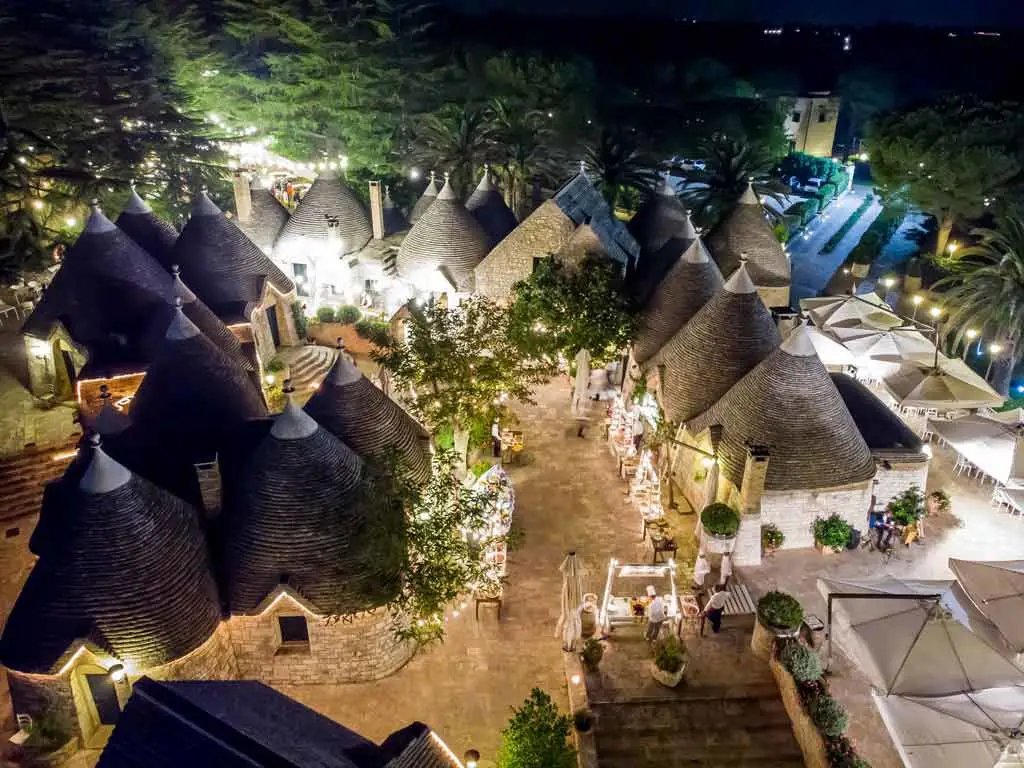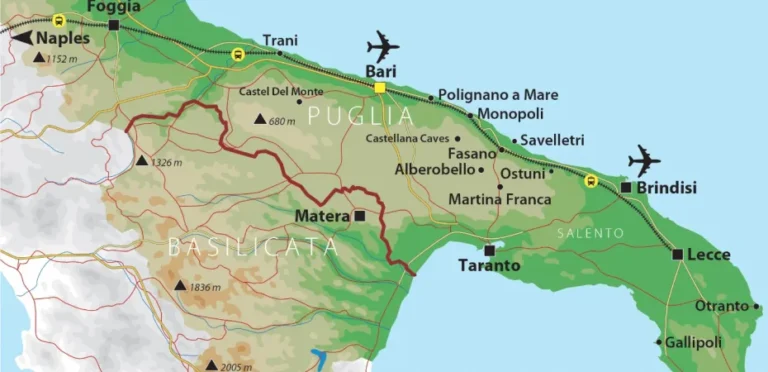



Alberobello is located a few kilometres from Monopoli and is easily accessible. Alberobello is a magical destination and unique in the world, famous for its trulli, extraordinary cone-roofed dwellings declared a UNESCO World Heritage Site. To visit it thoroughly and enjoy an unforgettable experience, it is advisable to explore it through its historic districts, cultural sites and panoramic viewpoints that give it charm and authenticity.
The main areas to visit
Rione Monti is the largest and most famous tourist district, with around 1,000 trulli. Here you can stroll through narrow cobbled streets, visit craft and souvenir shops, and admire unusual buildings such as the Trulli Siamesi, with two joined cones that tell a local legend.
Rione Aia Piccola is the smallest and most authentic area, still inhabited, where the trulli retain their traditional residential use. Here you can enjoy everyday life away from the tourist crowds.
Places and monuments not to be missed
Trullo Sovrano: this is the largest trullo in the town and the only one with two floors. A visit to its museum allows you to discover the history and architecture of the region, as well as see the original furnishings from the early 20th century.
Church of Sant'Antonio: a trullo-shaped church in the heart of the Monti district, a symbol of faith and local architectural peculiarity.
Casa Pezzolla: a complex of 15 interconnected trulli houses the Local History Museum, with exhibitions on the history and culture of the Itria Valley.
Casa D'Amore: historic building dating back to 1797, the first to be built after Alberobello was freed from taxes, bearing witness to an important historical past.
Experiences not to be missed
Visit artisan workshops to observe the techniques used to build trulli and purchase local products.
Climb up to Belvedere Santa Lucia, the most famous viewpoint for admiring the expanse of conical roofs from above, perfect for evocative photos, especially at sunset.
Stroll leisurely through the cobbled streets, immersing yourself in the fairytale atmosphere of this charming village.
If possible, arrange a visit with an authorised guide or use a map to take in all the historical and cultural details.
With a well-organised day, you can visit the key sites on foot without rushing, while a longer stay will also allow you to explore the surroundings of the Itria Valley, further enriching your discovery of this corner of Puglia, rich in tradition and beauty.
Ideal 1-day itinerary in Alberobello with recommended times
Here is an ideal itinerary for visiting Alberobello in one day, with recommended times to best experience the magic of the trulli and discover the most important places without rushing.
1-day itinerary in Alberobello
9:00 – 10:30: Monti district
Start your day in the most famous neighbourhood, Rione Monti. Stroll through the streets lined with trulli, visit the local craft shops and stop at the Siamese trulli for your first taste of history. Take advantage of the morning to take photos in the best light.
10:30 – 11:30: Sovereign Trullo
Visit Trullo Sovrano, the largest and most fascinating trullo in the town, with its museum recounting the history and typical architecture. It is an unmissable stop for understanding the culture of Alberobello.
11:30 a.m. – 12:00 p.m.: Church of St. Anthony
Not far from Trullo Sovrano, visit the trullo-shaped church to appreciate its unique architecture and the spiritual value of the place.
12:00 – 13:00: Traditional lunch
Choose one of the traditional restaurants in the city centre to enjoy authentic Apulian dishes, such as orecchiette, focaccia barese or panzerotti.
1:00 p.m. – 2:30 p.m.: Aia Piccola district
After lunch, head to the most authentic and least touristy neighbourhood, where the trulli are still inhabited. Here you can appreciate the daily life of the locals and the tranquillity of the village.
2:30pm – 3:30pm: Casa Pezzolla and Local History Museum
Visit this complex of interconnected trulli houses, which hosts exhibitions on the history, customs and culture of the Itria Valley.
3:30pm – 4:30pm: Casa D’Amore and walk through the historic centre
Take advantage of the afternoon to visit this historic building and stroll leisurely through the streets, stopping to observe the details of the houses and perhaps stopping for a coffee or a tasting of local products.
4:30pm – 5:30pm: Santa Lucia Viewpoint
End the day by climbing up to Belvedere Santa Lucia, the viewpoint from which you can enjoy spectacular views of the trulli roofs, which are particularly striking at sunset.
This itinerary allows you to discover the historical, cultural and architectural riches of Alberobello at a relaxed pace, ideal for an immersive and complete experience in a single day.
The Trullo: history and characteristics
The trullo is a traditional dry stone construction typical of central-southern Puglia, with its conical shape derived from the evolution of the prehistoric and ancient Greek model of the thòlos, a dome shaped like a mound. The trulli of Alberobello, which are the most famous and concentrated example, have been declared a UNESCO World Heritage Site since 1996.
Their origins probably date back to the 14th century, but it was in the 15th century that they became widespread, linked to historical and fiscal reasons: in the Kingdom of Naples, there was a law, the “Prammatica de Baronibus”, which imposed very high taxes on every new residential building. To evade these taxes, local lords forced peasants to construct buildings without mortar, i.e. dry-stone, so that they could be quickly dismantled in the event of an inspection to avoid taxation. This technique gave rise to structures that were sturdy but easily demolished, such as trulli.
Trulli were originally rural buildings used as temporary shelters, storage areas or dwellings for farmers and shepherds. They were made from local limestone, gathered without any binding material, with thick walls that provided thermal insulation, keeping the interior cool in summer and warm in winter. The conical shape of the roof is also functional, allowing rainwater to drain easily and creating a unique and striking aesthetic.
Over time, trulli have evolved from simple single-room structures to complexes of interconnected rooms, becoming permanent dwellings of great charm. The concentration of these buildings and their unique characteristics have made Alberobello a unique destination, as well as a symbol of Mediterranean rural architecture.
In summary, the trullo is a dry stone construction with a conical shape, created for practical and fiscal reasons, which has evolved into a distinctive cultural and architectural symbol of Puglia.
How trulli were built
The construction of a trullo followed a very particular and ingenious craft technique, based on the exclusive use of local limestone, without mortar or cement, which is called “dry stone walling”. Here are the main steps for building a trullo, as traditionally performed:
Excavation and foundations: Work began with the excavation of the ground to create an underground water cistern for collecting rainwater. The stones extracted during the excavation were reused in the construction.
Construction of the walls: The thick, very sturdy walls, with an average thickness of 80 cm to 1.50 m, were built with large, irregular stones laid dry directly on the ground, creating a stable and insulating base. The planimetric shape was often square or circular.
Construction of the cone-shaped roof: The roof was built by laying concentric circles of stones (called “chiancarelle”) that became smaller and smaller as they rose upwards, ending with a “keystone”, a central stone that ensured the stability of the structure. This system worked thanks to the friction and interlocking of the stones, without the need for lime or cement.
Decorations and finishes: The roof could be decorated with white esoteric or religious symbols traced with ash, and a stone pinnacle finished off the top, considered a good luck charm or propitiatory element.
Waterproofing and water collection: The protruding cornice allowed rainwater to be collected and channelled through gutters into the cistern below.
Simple and functional interiors: Inside there was a hearth and niches carved into the thick walls. The wooden floor could be raised to create a mezzanine.
This construction, known locally as a “truddhu”, employed the “cuci e scuci” technique, meaning it could be quickly dismantled by removing the keystone, an advantage given the historical need to evade taxes and tax collectors in the past.
Trulli are thus a brilliant example of spontaneous dry stone architecture, capable of providing natural thermal insulation, stability and a unique and evocative aesthetic value.