

The ancient trade routes of central Puglia: when Monopoli was a gateway to the Mediterranean and a crossroads between East and West
When one thinks of central Puglia, one’s mind often turns to the sea, the sun-drenched beaches, the trulli, the centuries-old olive trees and the white villages of the Itria Valley. Yet, even before becoming one of the most popular destinations for modern-day tourism, this region had for centuries been a land of transit, exchange and encounter.
La Central Puglia It was not a suburb of the Mediterranean: it was a bridge. A place where one Roman roads crossed, maritime routes, agricultural trade, pilgrimages, merchants, sailors and people from different worlds. Monopoly, now known for its historic centre overlooking the sea and its crystal-clear coves, once had a important role in this story. His port, protected and well-positioned along the Adriatic coast, has for centuries been a a natural gateway to the East and a vital commercial outlet for the hinterland.
The geographical location of the Apulia has always been of strategic importance. Reaching out towards the Balkans and the eastern Mediterranean, this region has been a hub for centuries links between Italy and the other side of the Adriatic. Ships laden with goods, pilgrims bound for the Holy Land, Venetian merchants, travellers, officials and soldiers passed through this region, leaving a profound mark on the local culture. Central Apulia, in particular, benefited from two factors: a a coastline with plenty of natural harbours and a fertile hinterland, capable of producing oil, wine, cereals, almonds and other agricultural products that are in high demand in Mediterranean markets.
The sea was not just a landscape. It was a road.
The Via Traiana: the motorway of antiquity
One of the major trade routes One of the main roads of ancient Apulia was the Via Traiana, built during the Roman period to to connect Benevento to Brindisi, the Via Traiana represented an easier alternative to the Via Appia. It passed through major towns in Puglia and provided a quicker route to the port of Brindisi, from where ships set sail for Greece and the East.
For the merchants It was a road precious. Along its route, the following passed through agricultural produce, manufactured goods, livestock, textiles, ceramics and goods destined for urban and port markets. It was not merely a military or administrative route: it was a major economic infrastructure. It linked towns, the countryside, ports and markets, speeding up travel and fostering the development of the towns and villages along its route.
Egnazia: the great crossroads of the Adriatic coast
Among the places a symbol of the ancient trade routes in central Puglia there is Egnatia. Located between Monopoli and Fasano, Egnazia was initially an important Messapian centre and then one Roman city of great importance. Its location was ideal: overlooking by the sea, near Via Traiana and linked to the agricultural hinterland.
This is where they used to meet land and sea transport. The port facilitated the exchange of goods with other cities along the Adriatic, whilst the Roman road ensured swift connections with the rest of the peninsula. Walking through the Egnazia Archaeological Park today means stepping into a city that for centuries thrived on trade, connections and activity. The paved streets, the necropolises, the walls and the remains of the buildings tell a open community, crossed by various influences.
From the decline of Egnazia to the rise of Monopoli
As the centuries passed, Egnazia’s importance gradually declined. New political balances, economic transformations and changes in trade routes favoured other coastal centres. Monopoli stood out amongst them.
His natural harbour, sheltered and close to a a very productive hinterland, it grew in importance. Monopoli succeeded in building on part of the coast’s commercial heritage, developing into a vibrant and strategic maritime centre. The village grew up around the harbour and to its needs: warehouses, shops, merchant buildings, places of worship, fortifications and spaces dedicated to trade.
The port of Monopoli in the Middle Ages
During the Middle Ages, Monopoli became one of the busiest ports on the southern Adriatic. The port did not was needed only the city, but also the surrounding hinterland. Agricultural produce intended for trade arrived from the countryside: olive oil, wine, almonds, cereals, dried figs and other typical Apulian produce.
These goods were collected, stored and then shipped to other ports in the Adriatic and the Mediterranean. At the same time, products from far afield arrived in Monopoli: textiles, spices, handicrafts, metals and valuable goods. The port was therefore a place of work, but also a meeting place. Sailors, craftsmen, merchants, notaries, landowners and travellers moved about in a dynamic environment, in which the town was constantly opening up to the outside world.
The Adriatic trade routes and relations with Venice
One of the most interesting chapters in the commercial history of Apulia concerns its relations with the cities of the northern and eastern Adriatic. Venice, Ragusa, Ancona and other coastal towns They were key players in a very extensive commercial network. Thanks to its location, Monopoli was part of these networks.
The ships which plied the Adriatic linked the Apulian coast with the markets of the Balkans and the East. Agricultural produce from Puglia was in particularly high demand, whilst Exotic goods, fabrics and hard-to-find products arrived from the other side in the hinterland. These exchanges helped to make Monopoli an economically vibrant and culturally open town.
The farmsteads and the role of the hinterland
The ancient trade routes of central Puglia were not limited to major ports and sea routes. A key part of this history unfolded in the hinterland. The the countryside around Monopoli, Fasano, Conversano and the Itria Valley They were criss-crossed by country lanes, sheep tracks and farm tracks used to transport goods to the coast.
The farmhouses were the productive heart of this system. They were not simply country dwellings, but genuine economic organisations. Here, olive oil, wine, cereals, cheese and other goods were produced for local consumption and trade. Many farmsteads had oil mills, storehouses, stables, inner courtyards and defensive structures. Some were fortified precisely because they housed valuable goods and were situated in areas vulnerable to raids and transit routes.
Oil, wine and wheat: the goods that were transported from Puglia
The commercial prosperity of central Puglia was closely linked to the fertility of its land. Olive oil It was one of the most important products. Used for nutrition, lighting and various artisanal uses, was a valuable and sought-after commodity. The wine It was another key product, alongside the cereals, at almonds, to the dried figs and to the dairy products.
These products still reflect the identity of the region today. It is no coincidence that visitors to Monopoli and the Itria Valley find the local cuisine to be one of the most authentic experiences. The historic centre of Monopoli still retains the spirit of a trading town: theand the narrow streets, courtyards, stately homes and buildings overlooking the harbour tell the story of a past in which daily life was closely linked to trade.
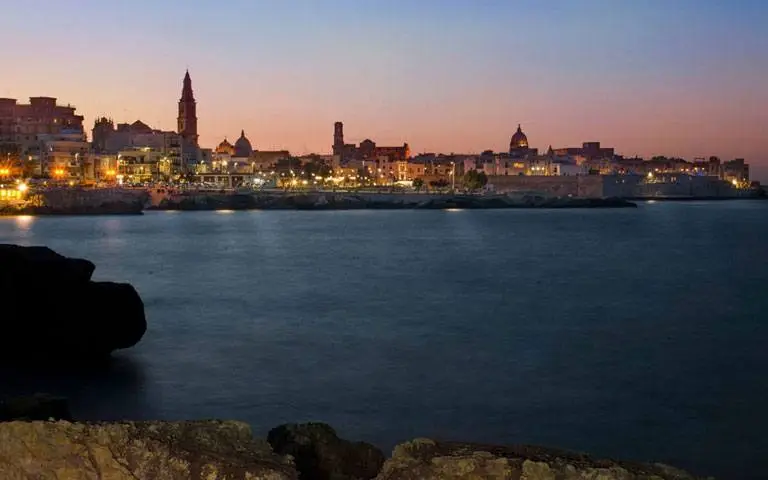
Many places that now look picturesque once served a practical purpose: storing goods, protecting the city, facilitating the arrival and departure of ships, and hosting craft and commercial activities. The old harbour, with its colourful boats and the white silhouette of the historic centre, is now one of the city’s most photographed spots. But before it became a picture-postcard scene, it was an essential piece of economic infrastructure.
Fortifications and the defence of trade
Where there are goods and wealth, there is also a need for protection. The walls, the ramparts and the Castle Charles V bear witness to Monopoli’s strategic importance. The town had to defend itself against raids, attacks and threats from the sea. The fortifications They didn’t just have one military role. They also protected the harbour, the warehouses, the economic activities and the population who made a living from trade.
The Castle of Charles V, overlooking the sea, is one of the most striking symbols of this need. Its location illustrates the link between defence, power and control of sea routes.
Pilgrims, travellers and cultural exchanges
The ancient trade routes were not only used to transport goods. Travelling along the roads of central Puglia were also pilgrims, members of religious orders, officials, soldiers and travellers on their way to the ports of embarkation for the East. This continuous movement encouraged the the spread of religions, traditions, languages and knowledge. Port towns, such as Monopoli, were places where the wider world came in every day.
Even the churches, the religious festivals and a few traditions local phenomena can be interpreted as the result of a long-standing cultural stratification. Visitors to Monopoli can turn this story into a travel itinerary. The route can start from the Old Port, the symbolic heart of the commercial city. From here, you can reach the Castle of Charles V, stroll along the walls and then lose yourself amongst the vehicles in the historic centre.
A second step could be the Egnazia Archaeological Park, which is ideal for understanding the role of the coast during the Messapian and Roman periods. From Egnazia, you can continue on towards the country farmhouses Monopoli and Fasano, many of which today tell the story of the region’s agricultural history through their architecture, olive mills and landscapes of olive trees. Finally, it is well worth visiting Conversano, a village in the hinterland with a long political and cultural history, linked to the agricultural and administrative life of central Puglia.
Why this story is also of interest to today’s traveller
Telling the stories of the the ancient trade routes of Puglia Focusing on the past does not simply mean talking about it. It means offering travellers a different perspective from which to interpret the area. Those who come to Monopoli for the sea thus discover a more complex town, characterised by layers of history, Mediterranean connections and productive landscapes.
A holiday here can be much more than just a beach holiday. It can include walks through the historic centre, visits to archaeological sites, tours of farmhouses, olive oil and wine tastings, and excursions to the villages of the Itria Valley. It is precisely this combination of sea, culture and the local area that makes Monopoli an ideal base for exploring central Puglia.
Discover holiday homes in Monopoli
Select a holiday home in Monopoli It means experiencing a region that is not limited to its beaches. From the old harbour From the farmsteads and the narrow streets of the historic centre to the Egnazia Archaeological Park, every place tells a story of central Puglia’s long commercial history. Discover holiday homes in Monopoli and let yourself be guided by a town that, for centuries, has regarded the sea as an open gateway to the Mediterranean.
FAQ on the ancient trade routes of central Puglia
- What were the main trade routes in central Puglia?
Among the main trade routes in central Apulia were the Via Traiana, the rural roads of the hinterland and the maritime routes of the Adriatic. - Why was Monopoli important for trade?
Monopoli was important because of its port, which linked the agricultural hinterland of Apulia to the markets of the Adriatic and the Mediterranean. - What role did Egnazia play?
Egnazia was an important Messapian and Roman centre situated between Monopoli and Fasano, with links to both the sea and the Via Traiana. - What goods were exported from central Puglia?
The main goods were olive oil, wine, cereals, almonds, dried figs and agricultural produce from the countryside and farmsteads. - Is it possible to visit the sites of the ancient trade routes today?
Yes. The Old Port of Monopoli, the Castle of Charles V, the historic centre, the Egnazia Archaeological Park and the farmhouses in the countryside still offer visitors the chance to discover this history today. - Why visit Monopoli apart from its beaches?
Monopoli boasts a rich historical and cultural heritage, linked to the sea, trade, fortifications and its relationship with the Apulian hinterland.